
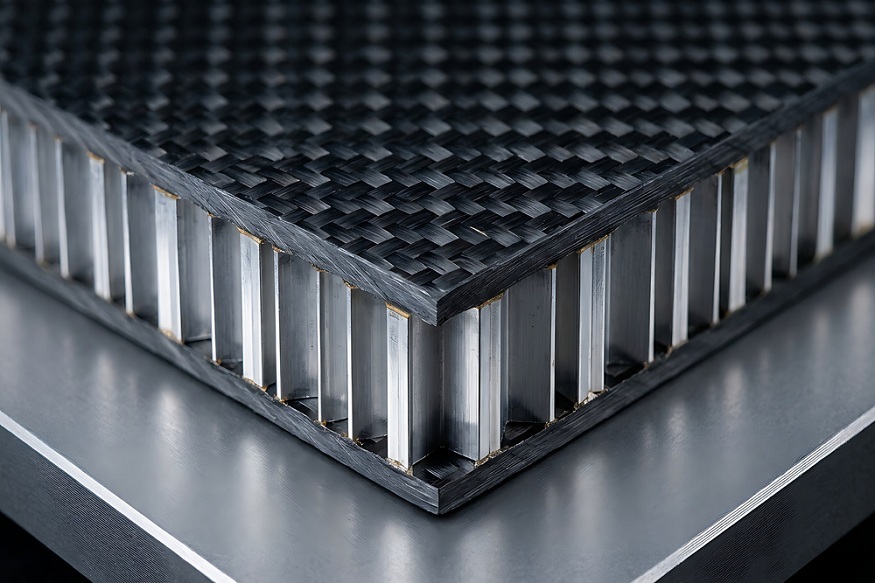
Slice through an airliner’s floor panel and you will mostly find air. A honeycomb core runs about 95 percent empty. Yet it carries galley carts, rolling luggage, and a cabin full of people shifting around at cruise altitude. Sounds like a con. It is really just geometry, put to work in a way that most of us never stop to think about.
Shape Beats Bulk
Hexagons divide up space better than almost anything else. Bees sorted that out a long time ago, with no engineering degree involved. Pack six sided cells together and no gaps get left over, and since every wall does double duty for the cell next door, a very small amount of material ends up covering a very large area.
It Works as a Sandwich
Core rarely goes it alone. Apply a thin layer of carbon fiber or fiberglass to each side. Then the entire stack will behave as a single thick slab instead of three individual pieces. The skins take the pulling and squeezing. The key role of the core is to keep them spaced apart and prevent any sliding from happening.
Read More: Why More Payment Options Don’t Always Mean an Easier Payment Experience
As thickness increases, stiffness rises dramatically. Spacing those skins further apart results in significant benefits. If the thickness is doubled, it can result in approximately eight times the bending stiffness. All while the weight remains almost unchanged. That math is crucial for the development and function of aircraft interiors, radomes, flaps, and fairings.
Cores Come in Flavors
Because aluminum honeycomb collapses in a reliable way, engineers favor it for dissipating impact energy. Aramid paper cores, often soaked in phenolic resin, offer a unique range of capabilities. No corrosion. Good flame resistance. And they let radar and radio waves slip right through, which aluminum will never do.
Then there is cell size, which trips up more people than you would expect. Tight cells support thin skins nicely and leave a smoother surface. Wider cells shave weight and cost. Mix the wrong skin with the wrong cell, though, and the face sheet sags slightly between the walls until your finished panel looks faintly like a golf ball.
Why Your Supplier Matters More Than You Think
Core looks dead simple on a spec sheet. Try building two thousand identical panels and that changes fast. Wall thickness has to stay consistent, resin coating has to go on evenly, and ribbon direction needs clear marking. This is because the core is considerably stronger one way than the other. Manufacturers working with an established Nomex honeycomb core supplier such as Axiom Materials get dependable core alongside matched adhesive films. It is this pairing keeps bond quality steady batch after batch. Solid materials quietly make a panel shop look brilliant.
Speaking of bonds, that is usually where trouble starts. Adhesive needs to pull up into a tiny fillet wherever a cell wall touches the skin. Skip that and the panel can pass a visual check, then peel apart later.
Read More: The Secret Weapon of the Fortune 500: A Niche B2B Marketing Agency
The Trade Offs
Water is honeycomb’s nemesis. Let moisture creep through a cracked skin and it pools inside the cells, adds weight, then freezes at altitude and pries the bond open from within. Technicians treat small dents in sandwich panels seriously for exactly that reason. Point loads cause the other headache. Run a bolt through bare core and it collapses. Designers get around it by filling the area with dense potting compound or dropping in a solid insert first.
Conclusion
The strength of a honeycomb comes from the way it is arranged as opposed to the material it is made of. Organize a little material well enough, and air does the rest.